C#
Java
Unity Engine
Virtual Reality
After six years of studying, I successfully defended my master’s thesis today. And with this, a chapter that has been part of my everyday life for the better part of the last decade comes to an end.
I am incredibly grateful to everyone who supported me along this journey. My family and friends, my professors, colleagues and everyone who somehow had to deal with me talking about Virtual Reality, networks, statistics or some other strangely specific technical problem over the last six months.
Without that support I genuinely don’t think I could have done it.
But let’s start from the beginning… well not THE beginning. Let’s start six months ago.
Back to work
In my course of study everyone has to prove that they can independently work on a research problem, before they are allowed to start with their master’s thesis. After I had completed my previous academic research project and showed that I am capable of doing research on my own, I took a few days off but then jumped right back in.
Completing my master’s degree within the intended number of semesters was a personal goal of mine. My bachelor’s degree had taken me longer than originally planned, so this time I wanted to finish within the allotted timeframe. Whatever it took.
Luckily, I did not start from zero. One central goal of my prior project had been to create something that could serve as the technical foundation for my master’s project. For more information about this technical foundation have a look at this post.
So with the technical framework already in place, this time my first few weeks did not start inside the Unity Engine. They started with research papers. A lot of research papers.
What did I actually want to research?
My previous project ended with a topic I found extremely interesting: Transitional Interfaces and the question of how conventional desktop applications and immersive environments can work together without constantly breaking the user’s workflow.
There was only one problem. That topic is huge. Way too large for six moths. So instead I started looking at smaller pieces of immersive analytics that I could realistically investigate in this timeframe.
One topic kept appearing again and again: Navigation.
When arbitrary data, in my case visualized as networks, is represented spatially in Virtual Reality, analysing it often requires to navigate trough it. Users have to approach elements, inspect structures from different positions, remember where things are located or understand the connection between certain parts and the data in a whole.
My thesis underlines, that navigation in this sense is not just a convenient way of getting from A to B but an integral part of the actual analysis process and how users are able to understand the navigated data.
But while this is already known and focused upon by other papers, while reading through the existing literature, I kept running into one very physical problem.
Virtual space is cheap. Real space is not.
A virtual environment can be as large as you want it to be. Your room cannot. Also natural walking is arguably the most straightforward way to travel in Virtual Reality. You simply walk somewhere and your virtual position does the same.
Great… until there is a wall, or a plant, a chair or your friend watching you stumbling around.
But luckily there are plenty of navigation techniques designed to solve this exact problem. Teleportation, Walking-in-Place, World in Miniature, Redirected Walking and many others allow the user to explore endless virtual spaces with limited physical space.
But while comparing existing studies, one thing caught my attention. The available physical space was often simply treated as part of the experimental setup. One study had a certain tracking area. Another had a different one. I was interested in finding out what happens if the available physical space itself becomes an experimental factor. Does the size of the real room change how useful a navigation technique is? And more importantly does it change how well users understand the network they are exploring?
This became the central idea behind my thesis.
Okay… how do you test that?
This is where the project became considerably larger than I initially imagined. Therefore I will spare you most of the implementation work and just write about the essential navigation.
I wanted to compare navigation techniques that differ in how closely virtual movement is connected to actual physical movement under different physical constraints.
The first technique was Redirected Walking, or RDW.
With RDW, the user still physically walks through the room, but their virtual movement is altered by small manipulations. For example distances or rotations can be subtly altered without the user noticing it. My implementation combines such manipulations using translation, rotation and curvature gains and an additional reset method when the user could no longer be held within the boundaries using these manipulations. With this you can navigate endless virtual worlds with limited physical space.
The second technique was World in Miniature, or WIM.
Opposite to RDW, WIM is completely abstract, meaning completely unbound from the users real movement. The user holds a miniature representation of the virtual environment in their hand. Whenever a small humanoid figure within the miniature is being moved, the user itself is moved accordingly in the real-size virtual room.
So I had a strongly embedded and a strongly abstract navigation technique. I needed something in between. Something where a physical action initiates the movement, while the resulting locomotion is completely abstract. Also it had to be usable without controllers since they would be used for other interactions.
After a long thought process I made people navigate by nodding.
Yes. Nodding.
The third technique was a newly created technique called Nod-Driven-Jumper, or NDJ. A nod forward, backward, left or right triggers a discrete virtual movement in that direction. Because apparently six months of master’s thesis work was not complicated enough so I had to invent a new navigation technique.
The actual implementation was tougher than I thought. I did not just need to check if someone’s head moved. I had to realize that every user could nod in a different way. So every participant first had to calibrate their individual nodding behaviour. The system measured certain properties such as angular velocities or certain angles and created individual thresholds to distinguish an intentional nod from someone simply looking around.
With the last technique being unnecessarily complicated but finally implemented I had all three navigation techniques I wanted to compare. Now I just needed some different physical constraints I could compare against these techniques.
3 x 3, 5 x 5 and 9 x 9 meters
The virtual environment itself remained always 9 x 9 meters in size. What changed was the amount of physical space participants were allowed to use to explore this 9 x 9 meter virtual room. For this I chose three tracking areas:
3 x 3m representing a heavily constrained Room-Scale VR setup.
5 x 5m allowed considerably longer physical movement but still restricted the user.
And in 9 x 9m, the physical and the virtual space were equal in size, meaning that theoretically every point in the virtual environment could be reached through physical movement alone without any obstacles.
Building the experiment
Since the thesis was still based on the VANTED and GAV-VR system from my previous project, I continued using biological networks as underlying data. And because throwing participants into a giant biological network would probably not have helped anyone, I designed the VR-visualization around a more familiar metaphor of a star map.
Nodes became glowing stars connected through the network. Their original colours remained visible, larger nodes became larger stars and labels appeared when users approached them, showing their biological names and with that closing the circle back to their biological meaning.
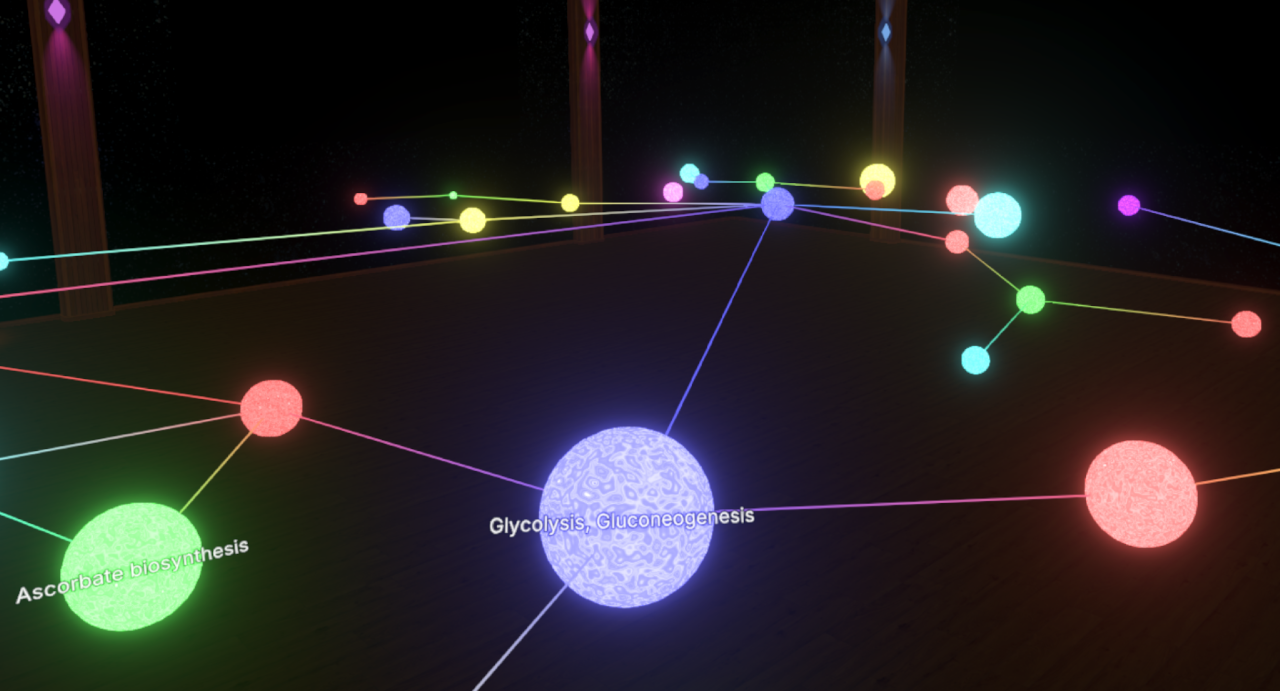
I intentionally kept the network planar instead of distributing everything freely through the third dimension. The goal was not to test a fancy new visualization. The visualization needed to remain as controlled as possible so that the actual experimental factors like the navigation technique and the physical space stayed in the focus.
Measuring something you can’t directly measure
There was another problem. How do you measure whether someone actually understood the network while navigating it with certain techniques and under certain constraints? You cannot exactly ask someone’s brain “Hey, how good is your mental representation of this network from zero to ten?”.
So I broke the idea of network understanding down into three aspects:
- remembering relevant network elements,
- remembering local connections between elements
- and understanding the overall spatial structure of the network
Each of those received its own task that participants had to do. In every task they first had 90 seconds to freely explore the network while three elements were highlighted in particular. Only after that exploration was over did they learn what aspect they where asked to reproduce.
The first task required them to find a previously highlighted node again in a network where now every node looks the same.
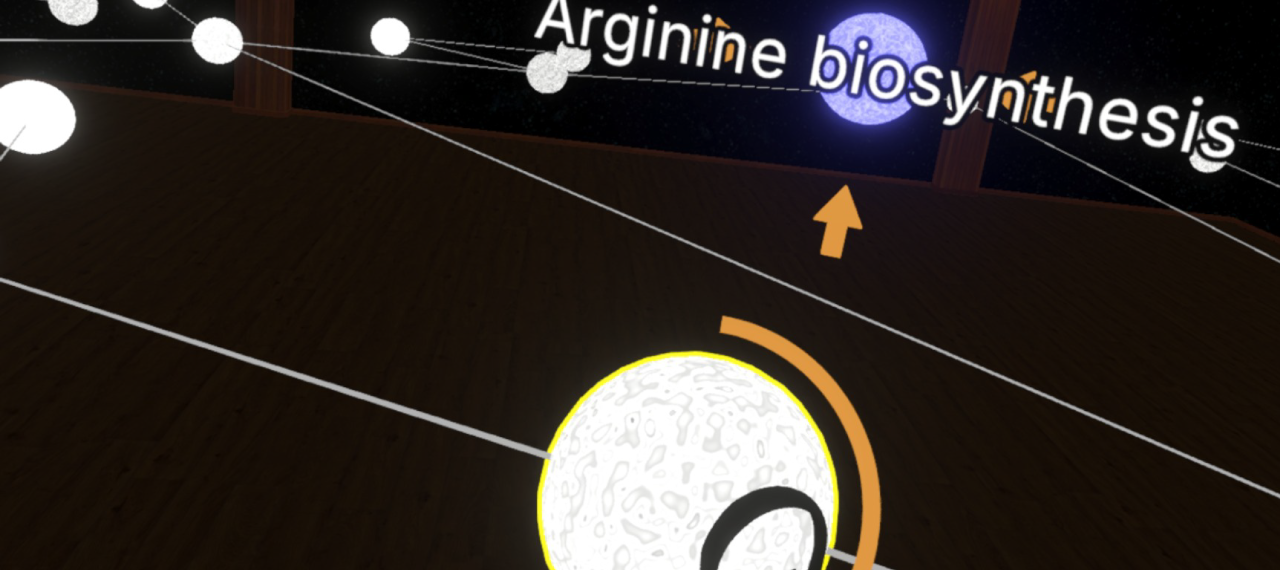
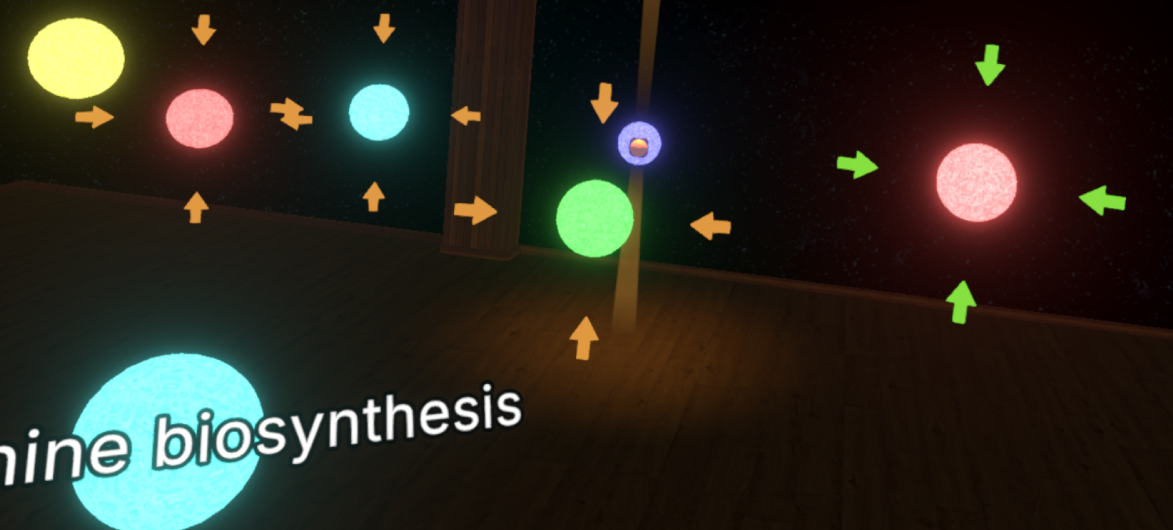
Another removed all visible connections and asked which surrounding nodes had originally been directly connected to a target.
And for the final task, the entire network disappeared. Participants then had to point towards the remembered location of a specific network element using only the spatial mental representation they built during the exploration.
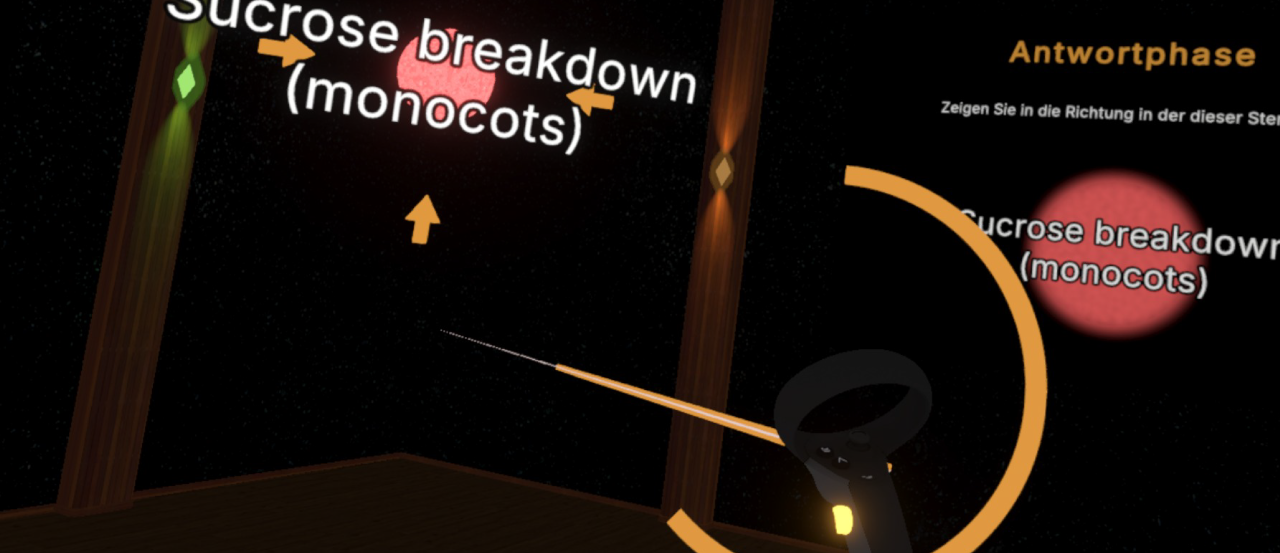
Every task evaluated how accurate and efficient the participants submitted their answers. In other words combining the results of those independent and measurable tasks gave me insight over how good or bad a user had build an understanding of the network.
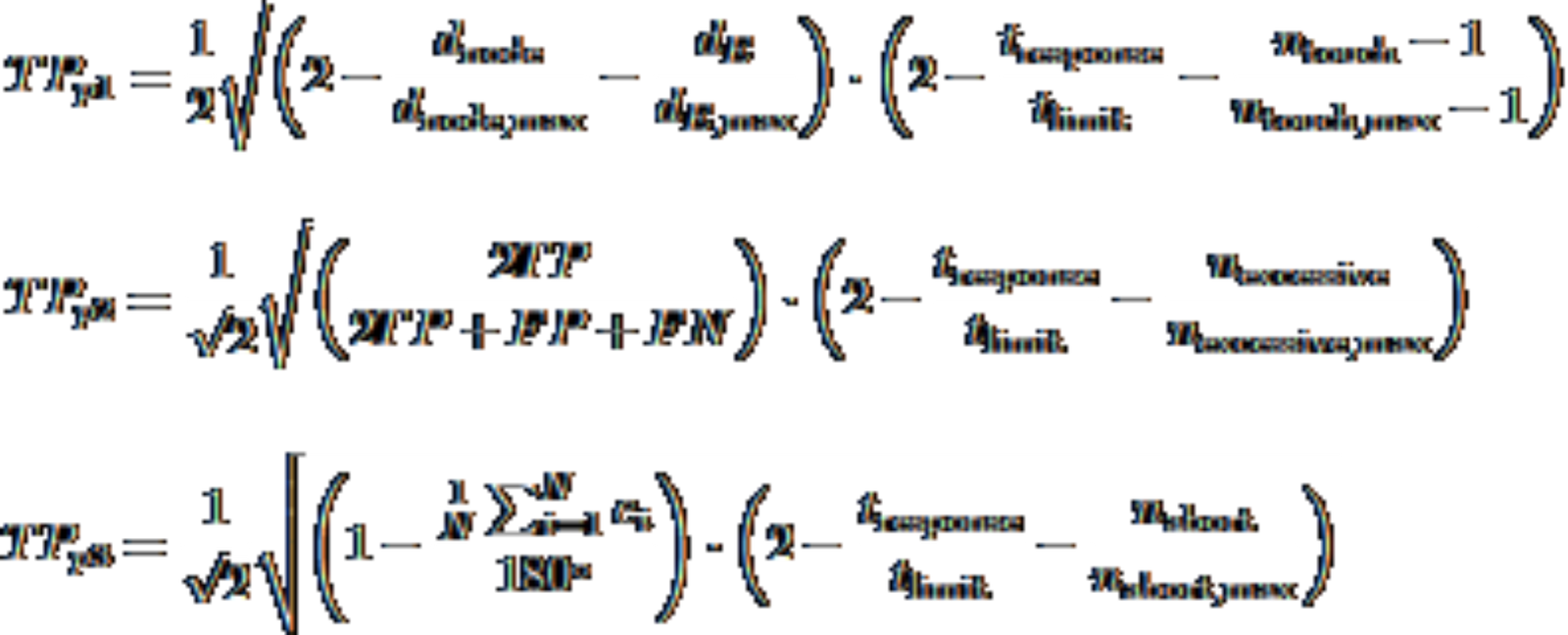
In concept great… but realising those measurements and combining them to one single mathematically correct model was something I had never done before. Countless hours and headaches later I had concrete formulas and was ready to work with any data coming my way.
But I will spare you the details. If you are interested in this part you can read the full derivation in my thesis.
And then people actually had to use it.
After months of research, designing, implementing, rebuilding, testing, breaking things, fixing things and probably spending far too much time aligning virtual and physical coordinate systems, the user study finally started.
Fifteen participants completed the experiments. Each worked through nine experimental tasks across different combinations of navigation technique, physical room size and network task. The conditions were counterbalanced to reduce learning, fatigue and ordering effects as much as possible without turning the experiment into an all-day VR endurance test.
And because the largest condition required and actual 9 x 9m tracking area, I also got the pleasure of turning a rather large physical room into my experimental playground. The study used a Meta Quest 3 wirelessly connected to the evaluation system, with a dedicated local network providing the connection.
Then came the part I had been dreading, the statistics.
So… what happened?
After all of that setup, implementation and experimentation, the central statistical result was:
Nothing significant.
Which might sound slightly devastating on the first glance. And I certainly felt this way at first as well, but it is also not the same thing as saying nothing happened.
Under the conditions of my study, I could not demonstrate a statistically significant influence of the navigation technique, the available physical space or the interaction between both on the measured network understanding.
That does not mean physical space never matters. And it certainly does not mean all navigation techniques are identical. Because the actual navigation process looked quite different.
Redirected Walking reacted strongly to the available room size. As the physical tracking space increased, the number and cumulative duration of necessary reorientation processes decreased substantially.
So the way people moved clearly changed. This change just was not enough to show statistically significant influence. Participants could for example have countered the constraints by adjusting their strategies.
And that turned out to be one of the more interesting conclusions of the entire thesis. Navigation under certain physical constraints may change the way you reach an analytical result without necessarily changing the result itself.
Also… people really did not like my nodding idea
Objectively, none of the three navigation techniques proved universally superior. Subjectively people definitely had preferences. Nine participants preferred WIM, six preferred RDW and not a single participant preferred NDJ. Fourteen out of fifteen even rated NDJ as the most difficult technique.
The interesting part is that three participants actually achieved their best individual performances using NDJ but even so did not prefer the technique. Only four of the fifteen participants generally preferred the technique with which they objectively performed best.
That distinction between performance and experience became one of my favourite findings of my thesis. A system can produce good results and still feel terrible to use. And apparently repeatedly nodding your head to jump through a network is a pretty good demonstration of that.
WIM on the other hand, was the most preferred technique even though none of the participants had ever used it before.
Was that the result I expected?
Objectively and subjectively NO. And I think that is kind of the point.
I started this thesis expecting the physical room to influence how well certain navigation techniques support the exploration of immersive networks. What I ended up finding was much less clean of an answer. The available physical space clearly influenced parts of the navigation process, particularly the fragmentation of the navigation. Users also perceived and preferred the techniques very differently. But those differences did not translate to statistically significant differences in the network understanding I measured.
That lead to my thesis proposing a new question for future research. Much more interesting than simply asking which navigation technique is “best”, one should ask “Under which conditions do differences in the navigations process actually start affecting what users learn and understand about the data they explore?”
There are many more interesting findings that I simply cannot cover in a single blog post. So if this sparked your interest in the topic, I highly recommend taking a look at my full thesis, although it is written in german.
And then it was over
Six months after starting, I submitted my master’s thesis. And today, I defended it, which feels strange to write. For six years university has always been the next thing. The next semester. The next project. The next exam. The next deadline. There was always something next. This time there is no next semester.
But luckily finishing my degree does not mean leaving research behind or leaving university behind, for now. Quite the opposite. I am now continuing my work at the university of applied sciences Mittweida but this time not as a student but as part of its research environment, with Virtual Reality remaining a central part of what I do.
And there is already so much I want to do, so many questions I need answers for.
The topic of Transitional Interfaces that originally emerged from my previous project is still something I want to return to. I deliberately moved away from it for my master’s thesis because six months simply is not enough to tackle it properly. Also my implementation of WIM is something I want to explore in more depth by combining it with some gamification. I already have many great ideas where this could lead to funny and interesting projects.
But for now, I am just happy to say something I have been working towards for a very long time:
I am done
No next semester. No next exam. Master’s degree ✔